

Mechanical Engineering Group Laboratory
In the name of God
Specifications of Materials Strength Laboratory Equipment
Department of Mechanical Engineering
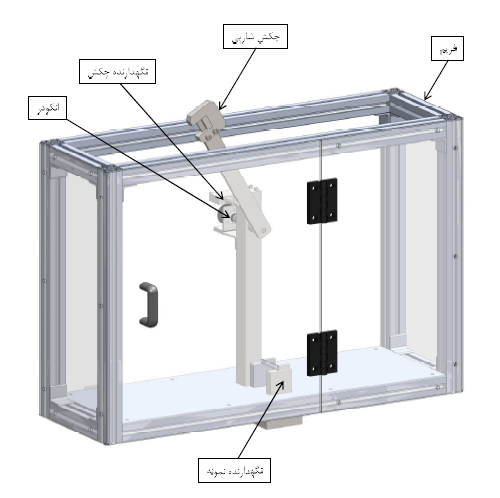
1- Charpy Impact Test Device
Using this device, we determine the amount of energy required to fracture a sample under impact loading. The Charpy impact test device consists of a pendulum with a specific mass that is released from a known height and strikes the sample. The energy transferred to the sample can be determined by the difference in the height of the hammer before and after the fracture, which is known as the absorbed energy during the fracture process.
Charpy Impact Test Device
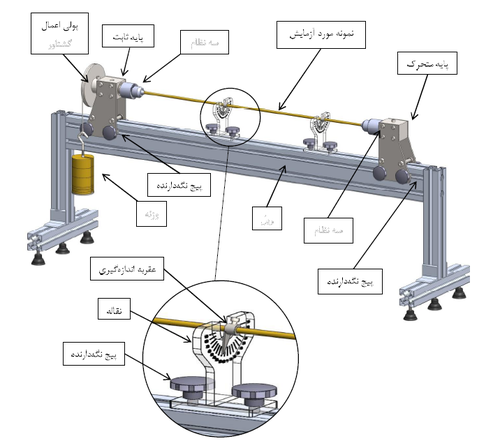
2- Elastic Torsion Test Device
With this device, the elastic torsion of rods with a circular cross-section can be calculated. The rods are placed in the device with one end fixed, and the other end is subjected to torsion in the elastic region using a pulley, weights, and applied torque. Using the input data, parameters such as the shear modulus of the sample or the amount of elastic torsion angle can be tested and calculated.
Elastic Torsion Test Device
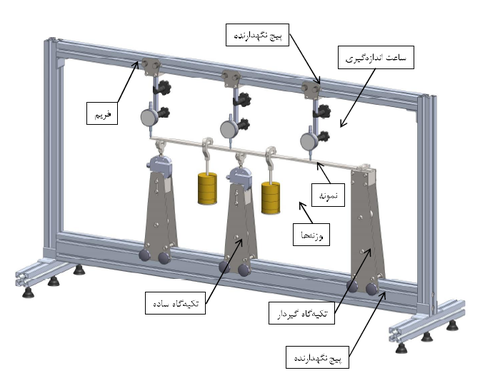
3- Elastic Bending Test Device for Beams
With this device, various beams with different dimensions can be subjected to bending loading in the elastic region, and the necessary bending information such as the elastic modulus, the first moment of area, the dimensions of the beam, or the amount of bending load can be calculated. The types of tests that can be performed with this device include bending loads on beams with two free supports and one free support and one fixed end, and the support forces can also be measured with the installed load cells. Measuring clocks are also used to calculate the amount of vertical bending displacement of the beams with an accuracy of 0.01 mm.
Device for Calculating Elastic Bending Deformation of Beams
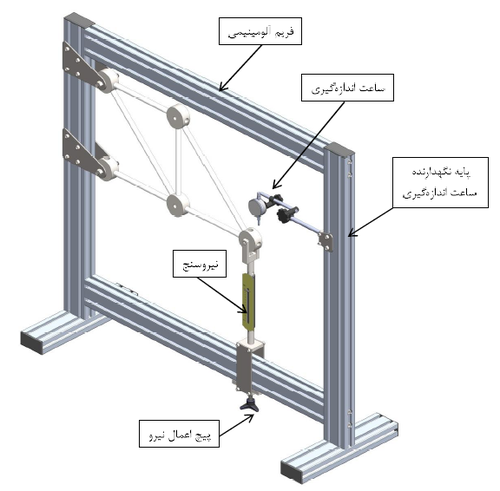
4- Truss Deformation Test Device
By using a 6-member truss that has 5 joints and applying a vertical load to the end of a joint with a screw, the amount of applied force and the general displacement and deflection of the truss can be calculated. The measuring clock calculates the amount of deflection with an accuracy of 0.01 mm. Also, the load cell at the end of the screw gives the amount of applied force with an accuracy of 1 Newton.
Truss Deformation Device
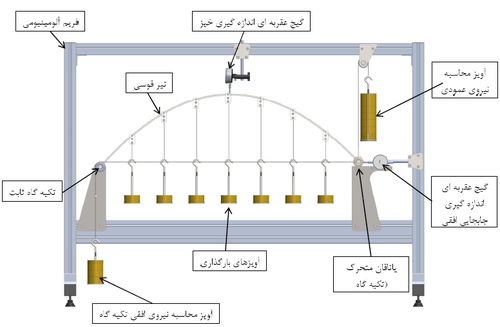
5- Arch Bridge Deflection and Force Test Device
The arch bridge deflection and force test device includes a curved beam as an arch bridge, on which hooks are placed at a one-year distance, which are subjected to point and concentrated loads, as well as distributed loads. Also, one side of the bridge is fixed, and the other side is open-ended, which has free horizontal movement, and with the designed mechanism, the support forces and loading forces can be calculated. The device has various measuring clocks to calculate deflections with an accuracy of 0.01 mm.
Arch Bridge Deflection and Force Test Device
6- Plastic Bending Test Device for Beams
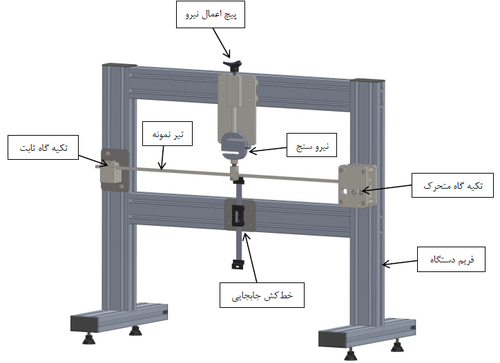
With this device, the amount of deflection and the critical force of plastic bending of beams are calculated. The device has a two-fixed-end beam, which, by twisting the screw, applies the amount of force to the center of the beam until entering the plastic region. Also, with the help of a moving ruler (similar to a caliper), the amount of plastic deflection is calculated.
Plastic Bending Test Device for Beams
7- Asymmetric Bending Test Device
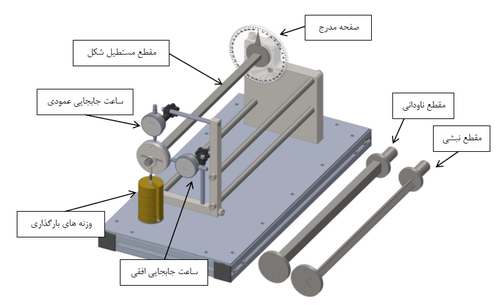
With the asymmetric bending test device, the amount of horizontal and vertical deflection of the channel-shaped beam can be calculated under the loading of weights applied to the end of the beam with one fixed end. By using a pulley and belt at the end of the beam and applying torque to the asymmetric channel-shaped beam, bending is created, and with measuring clocks with 0.01 mm, the amount of horizontal and vertical deflection of the end of the beam can be calculated.
Asymmetric Bending Test Device
Prepared and arranged by: Dr. Hossein Hatami, Faculty Member of the Department of Mechanical Engineering and Instructor of the Materials Strength Laboratory